
The Discipline of Staying Put
July 2026 Letter to Our Clients
Investing can teach us so much about human nature because it involves one of the biggest mirrors of the human psyche: money!
One of investing’s most familiar principles is to buy low and sell high. Yet investor behavior often reveals a profound gap between what people know and what they do.
When an investment falls in price, many investors instinctively want to move away from it. (Sell low!) When another produces exceptional returns, they may feel compelled to buy more. (Buy high!) Thus, investors follow their instincts and, in doing so, break the buy-low, sell-high maxim of investing.
By now, you know at Conscious Wealth we don’t really buy domestic mutual funds, and neither do any serious large investors. Nevertheless, we can all learn something from them.
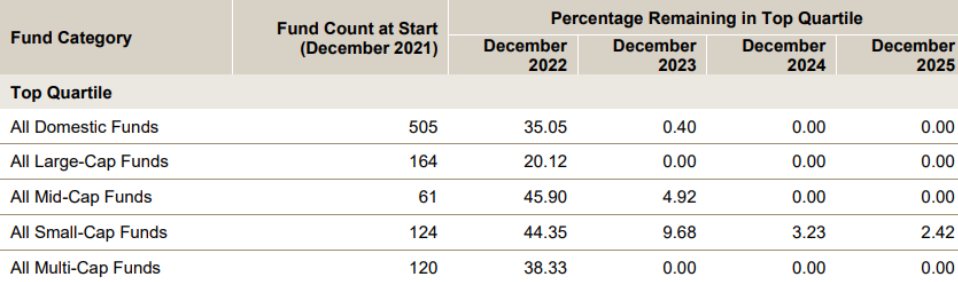
Of the domestic mutual funds that ranked in the top quartile for the 5-year period ending December 2021, only 35% remained in that top quartile just 1 year later. Two years later, hardly any of them did. By the end of 2024, not a single fund remained in the top quartile.
The lesson here: Strategies work, until they don’t, but then they do again. What the chart below doesn’t show is the inflows into the winning funds. Many investors have, at least once, looked at their 401(k) options and chosen the strongest recent performer. The facts show the best performer today may not be the best tomorrow.
What we propose is sticking with your convictions instead of jumping around from strategy to strategy. It’s important to believe in your investment strategy thesis.
Every thoughtful investment discipline—regardless of whether it emphasizes growth, value, quality, small companies, large companies, momentum, or something else—will experience seasons when it seems brilliant and others when it looks broken.
We’ve all heard it before: Past performance doesn’t guarantee future results.
Here’s the hard part, though: Markets are at all-time highs right now. But they won’t always stay up there, and that’s a fact.
Now is the time to examine what you own and then assess whether or not you’re willing to hold onto it through a market correction. Because market downturns trigger emotions, and emotions are great, but they can’t be trusted with investing decisions.
Markets will rotate. Leadership will change. Headlines will tempt investors to react fast. It will take great discipline to separate temporary performance from long-term conviction.
As I’ve alluded to above, our portfolios are performing exceptionally well. We are grateful for all the progress our clients have made. Our success is something we appreciate with humility—not because it guarantees what comes next, but because it reflects the value of remaining disciplined through periods when it’s much harder to maintain.
On that note, get out there and enjoy the summer! Find some lake time. Ride down a river on a tube. Eat fresh summer vegetables like tomatoes and cucumbers. There’s abundance all around us.
As always, thank you for the trust you place in us.
If you have questions about your portfolio, the markets, or simply want to revisit why you own what you own, we’d be glad to have those conversations with you.
In Abundance,
Brandon Hatton,
CEO & Chief Investment Officer
Subscribe
When Money Becomes a Game
What is happening in the prediction markets is very concerning! Prediction markets are a relatively new form of speculation where people can place financial bets on everything from elections and economic outcomes to cultural events and public figures. Prediction or more aptly named Gambling markets require your attention because they most likely hold the attention of someone you love.They can also slowly, or quite rapidly, eat away at your life’s work.
Read Now >>
When History Rhymes
There are moments in history that feel distant…until they begin to rhyme with the present. Unless you live under a rock, which is admittedly tempting these days, you’re probably looking at the situation of the Strait of Hormuz, as well as rising geopolitical tensions in the Middle East, and thinking about what it could all mean for markets, inflation, and the broader economy.
Read Now >>.png)
The Consigliere
Robert Duvall was born into a life shaped by structure. His father was a career Navy officer who rose to the rank of Rear Admiral. Like many military families, they often moved. The expectations were clear: discipline and duty mattered. But alongside that structure was something quieter. It was his mother's love for theater that introduced a different kind of influence—one that required observation, patience, and presence.
Read Now >>July 2026 Letter to Our Clients
Investing can teach us so much about human nature because it involves one of the biggest mirrors of the human psyche: money!
One of investing’s most familiar principles is to buy low and sell high. Yet investor behavior often reveals a profound gap between what people know and what they do.
When an investment falls in price, many investors instinctively want to move away from it. (Sell low!) When another produces exceptional returns, they may feel compelled to buy more. (Buy high!) Thus, investors follow their instincts and, in doing so, break the buy-low, sell-high maxim of investing.
By now, you know at Conscious Wealth we don’t really buy domestic mutual funds, and neither do any serious large investors. Nevertheless, we can all learn something from them.
Of the domestic mutual funds that ranked in the top quartile for the 5-year period ending December 2021, only 35% remained in that top quartile just 1 year later. Two years later, hardly any of them did. By the end of 2024, not a single fund remained in the top quartile.
The lesson here: Strategies work, until they don’t, but then they do again. What the chart below doesn’t show is the inflows into the winning funds. Many investors have, at least once, looked at their 401(k) options and chosen the strongest recent performer. The facts show the best performer today may not be the best tomorrow.
What we propose is sticking with your convictions instead of jumping around from strategy to strategy. It’s important to believe in your investment strategy thesis.
Every thoughtful investment discipline—regardless of whether it emphasizes growth, value, quality, small companies, large companies, momentum, or something else—will experience seasons when it seems brilliant and others when it looks broken.
We’ve all heard it before: Past performance doesn’t guarantee future results.
Here’s the hard part, though: Markets are at all-time highs right now. But they won’t always stay up there, and that’s a fact.
Now is the time to examine what you own and then assess whether or not you’re willing to hold onto it through a market correction. Because market downturns trigger emotions, and emotions are great, but they can’t be trusted with investing decisions.
Markets will rotate. Leadership will change. Headlines will tempt investors to react fast. It will take great discipline to separate temporary performance from long-term conviction.
As I’ve alluded to above, our portfolios are performing exceptionally well. We are grateful for all the progress our clients have made. Our success is something we appreciate with humility—not because it guarantees what comes next, but because it reflects the value of remaining disciplined through periods when it’s much harder to maintain.
On that note, get out there and enjoy the summer! Find some lake time. Ride down a river on a tube. Eat fresh summer vegetables like tomatoes and cucumbers. There’s abundance all around us.
As always, thank you for the trust you place in us.
If you have questions about your portfolio, the markets, or simply want to revisit why you own what you own, we’d be glad to have those conversations with you.
In Abundance,
Brandon Hatton,
CEO & Chief Investment Officer

