
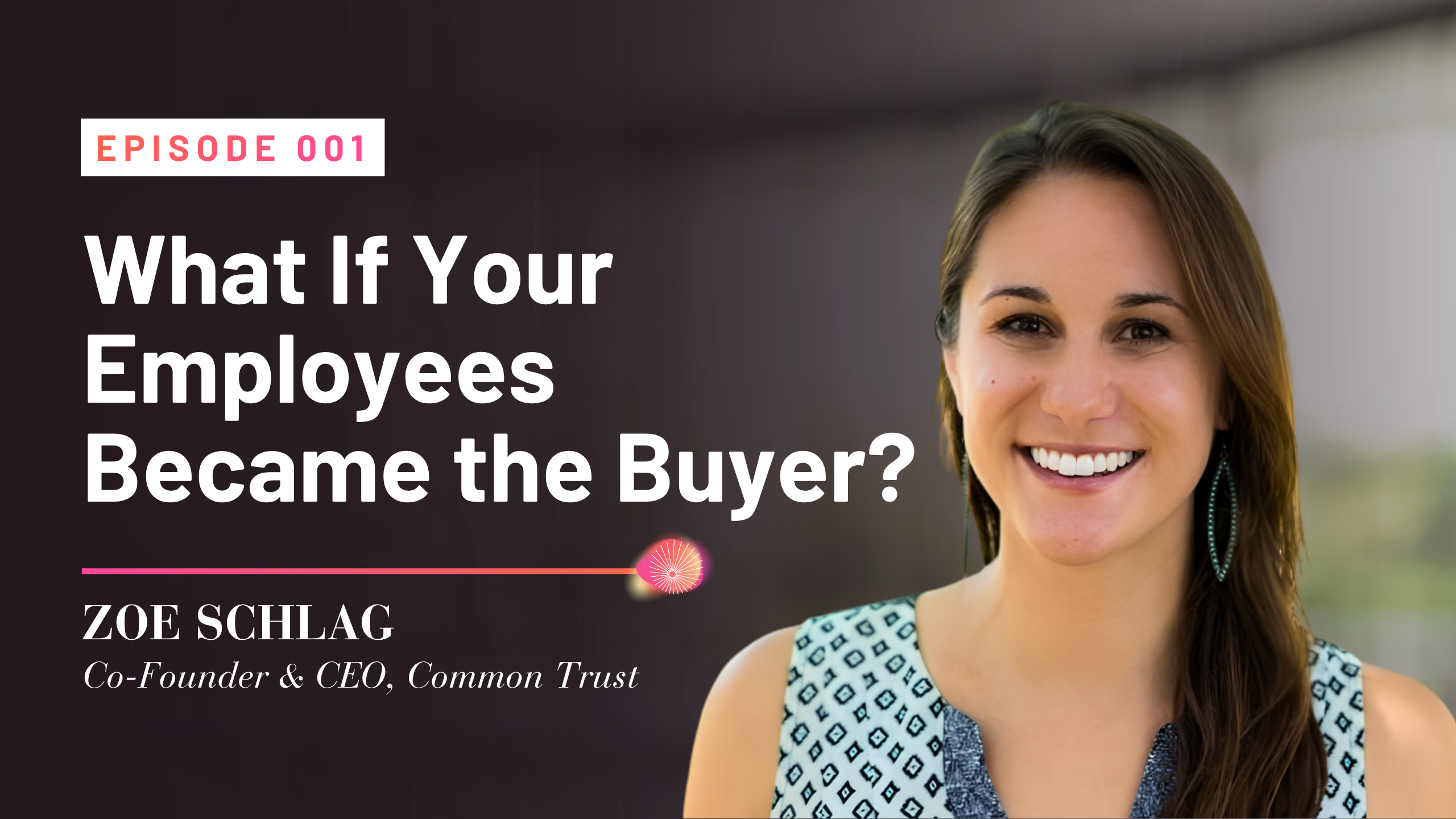
What If Your Employees Became the Buyer?
Regret came up early in my conversation with Zoe Schlag.
I’ve seen that regret live long after a business sale, especially when an owner watches the team, culture, or quality of the business change after they leave.
Zoe told me about an owner who put it simply: “I just want to be able to look people in the eye when I’m walking down the street.”
There is a human side to an exit that a valuation does not capture. Employees helped build the company. Customers have relationships with it. In some places, the business has become part of the community itself.
Employee ownership gave Zoe and me a practical way into that conversation. She works with Employee Ownership Trusts, or EOTs, which give employees an ownership interest while giving founders a structure for succession. Zoe also described how an EOT gives an owner room to protect values that matter to the company as they step away.
Then our conversation went somewhere I hadn’t planned.
I asked Zoe what ownership meant to her.
She connected ownership to agency and separated two ideas we often put together: control and economics. That led us to talk about the company itself as an ecosystem. A founder holds a particular role and takes particular risks, but value is created through many people whose work depends on one another.
I find that question worth sitting with.
If you are five years from an exit, there is time to think about the value of the business, who should own it next, and what you want to remain true after you leave.

.png)

Transcript
Brandon Hatton (00:08)
What happens when you sell your business? You end up with financial freedom, but you also have regret. Regret for the way that the sale went down. Well, today I'm talking with Zoe Schlag, founder of Common Trust, and we'll be talking about different ways to think about business secession and employee ownership.
So let's get into it.
Brandon (00:32)
Welcome Zoe. Yeah,
Zoe Schlag (00:34)
Thanks for having me. Glad to be here.
Brandon (00:36)
absolutely. Could you tell me a little bit about Common Trust and why you got called to do that work?
Zoe Schlag (00:42)
Well, let me start with why I started the company and what brought me to this space, because it's actually a little bit circuitous.
Brandon (00:50)
Yeah.
Zoe Schlag (00:51)
I've been an operator and investor for all of my career. I was working with a lot of very mission driven founders. So founders who were building companies to really solve social and environmental challenges or had
a really strong bench towards company values. And I loved that work, invested in some great teams. But being in that space as an early stage investor, I noticed this trend that I kept watching happen over and over again, which is, you know, these companies would scale, they would grow, and then they would go into exit. And I just kept seeing these scenarios where it was like, you know, a business owner would...
exit either to a strategic acquire, they get bought by private equity, what have you. And even though was a great financial exit, for one reason or another, they ended up regretting the sale. Either they
Brandon (01:40)
Yeah.
Zoe Schlag (01:40)
watched their teams get laid off, they watched the culture change, they watched the product quality or service quality suffer.
Brandon (01:48)
Yeah.
Zoe Schlag (01:49)
And watching that over and over again, I just kept asking myself, there must be a better way to do this because these are...
institutions that business owners have felt that they've poured their blood, sweat and tears and decades of their lives into. So I got really interested in is there a better way to do that and kind of went on a bit of a journey to explore ownership and the different approaches to ownership that exist. one of the trends that really got me interested is this wave of retiring
business owners right now. It's something like, you know, 70 % of businesses are projected to transition over the next decade, which is kind
Brandon (02:27)
Yes.
Zoe Schlag (02:27)
of insane to think about if you think about the fact that small businesses make up, you know, nearly 50 % of our GDP. And you know, what got me really interested in that is the number of buyers for these businesses, it's actually only going to absorb something like single digit percentage points. So even if we get everything right,
The way that our economy is structured today is just not prepared to absorb that turnover.
Brandon (02:53)
Mm-hmm.
Zoe Schlag (02:54)
At CommonTrust, we support businesses to exit through employee ownership. And I would say, you know, not everyone is going to draw a straight line between that problem and employee ownership. But what we got really interested in is employee ownership is really kind of an inbuilt buyer. You are looking at your team to support with succession. You can recruit folks in, but you're also using future company cashflow.
to support with the buyer. if you think about this massive wave of businesses transitioning, it's actually one of, in my mind, the most effective ways that we can support businesses to transition on to the next generation, just given the way that the economy is structured today. And the piece, coming back to my first story that I got really excited about, is employee ownership is one of those exit strategies that actually protects and strengthens those pieces that...
under these alternatives were put at risk. So employee ownership is something that doubles down on culture. It's something that doubles down on investing in your team and investing in greater products, product quality and services. And it's something that we've seen from the businesses that we've worked with. But when I put two and two together on those, we just got really excited about employee ownership as this opportunity to support these business owners.
employee ownership is not new. It has been around for a long time. In fact, some of the longest surviving businesses in the world are employee owned companies. So this is a model that's been around for a long, long time and has tremendous amount of track record. And part of where we are today is just really ensuring that business owners know that that's actually an option that they can consider.
Brandon (04:32)
a couple of things that stuck with me there is the regret. I think the regret is real.
Zoe Schlag (04:37)
Yeah, there's a statistic from the Exit Planning Institute, something like 75 % of business owners regret their sale within two years, which is crazy.
Brandon (04:45)
Yeah.
Yeah, within two years, and it took them probably decades to build it.
And that regret lives forever.
Zoe Schlag (04:53)
Yes.
Brandon (04:54)
I would imagine that there's a hyper local aspect to this in the sense that people don't want to go to the diner that they've been going to and seeing the people in the town know, he sold really big. And now we as a town aren't as good of a town because that business is no longer serving the people.
Zoe Schlag (05:13)
Yeah, it's funny, I was on a call with a business owner the other week and one of the things he said to me is he was just like, honestly, I just want to be able to look people in the eye when I'm walking down the street.
Brandon (05:23)
There's a real human aspect to what you're doing and it permeates throughout it all. There's a lot of humanity just in mission driven businesses. what I think there's not everybody really understands that or that might sound something esoteric, how would you define a mission driven business?
Zoe Schlag (05:39)
You know, I think there are different versions of it and of the business
Brandon (05:42)
Sure.
Zoe Schlag (05:42)
owners we work with, it looks different. So, you know, some of the businesses that we work with, they think about mission as like deeply embedded in their product or service. So there are some
Brandon (05:52)
Sure.
Zoe Schlag (05:53)
companies who are thinking about like their supply chain or what they're actually producing and selling and the mission that they're putting forth through that. Other companies we work with think about mission as it relates to their company values and culture and how they are.
supporting their teams. So this, you know, this may be a manufacturing business, but for them, mission is about how they invest in their team, how they contribute back to the community and how they're really a force for good for their employees and the families that those employees support. So I think there's actually a wide spectrum and, you know, I don't have a one is good, the other is not perspective on that. And rather, I
Brandon (06:31)
first one up. Yeah.
Zoe Schlag (06:33)
think any business owner who's really
Being thoughtful about what does mission mean to me and mean to our company in the context of what we do, there's plenty of opportunities to embed that. I'm curious to hear your perspective.
Brandon (06:48)
there's this whole spectrum between these polar opposites that mission-driven can take part of.
I guess you don't have to be, I don't use these words, but people do, a hippie, right? You don't
have to be some tree hugger to be a mission-driven company. You can be an entrepreneur, a business person, and very business-minded to serve people. And I like that openness to it because there are all these entry points and this doesn't have to be a thing. It could just be good business.
Zoe Schlag (07:20)
Yeah, I think that's right. mean, I would say it's totally agnostic to whatever side of the political spectrum you might sit on. And more is
Brandon (07:26)
Sure.
Zoe Schlag (07:27)
a function of exactly what you're talking about, which is, do I bring this to life in the context of my business? mean, I'll give you an example. Clegg Auto is a business we supported to transition almost four years ago at this point to employee ownership. It's an auto repair shop where they've
Brandon (07:42)
Yeah.
Zoe Schlag (07:43)
got four of them.
And so, you know, mission isn't necessarily embedded in like the service itself. But if you talk to Kevin Clegg, the CEO, he has this really deeply embedded mission about human potential and investing in his team and helping grow and develop his team. And since transitioning to employee ownership, you know, there's the structural part of employee ownership.
but there's also the operating model of employee ownership, which is how do you bring this sense of ownership to life? And Kevin has developed this entire training program for his team of workers at these auto shops
Brandon (08:22)
Yeah.
Zoe Schlag (08:22)
to really develop themselves individually, to be on kind of a leadership development track and understand their role in the business, but also how they show up in leaders in their community. And I think, you
Brandon (08:33)
Yeah!
Zoe Schlag (08:34)
know, there are so many professional development.
programs aimed at corporate America, and I think it's so powerful to see that in small businesses across America as well.
Brandon (08:46)
what you're describing is a human being who sees business as a platform for development, for growth.
personal growth for internal growth. there's a human element of mission driven businesses. There's a human element of not having somebody live the rest of their days with regret, which I also like. But then I also like that it's creating what I call generative generational wealth. And what I mean by that is a lot of people are like, I want generational wealth. And you're like, what does that mean?
get answers like a Ferrari or a yacht but like good or generative generational wealth is you're allowing people an opportunity to own something and maybe be able to put a down payment on a house for their kids or if their kids lose a job they don't have to worry about them going homeless or being able to afford health insurance.
a lot of our clients when I would mention to them, well, have you considered not selling to private equity but maybe selling to
your employees they'll be like ESOPs like are so hard what's new in the world that's not an ESOP which have gotten a bad name not necessarily true but what else is out there for them
Zoe Schlag (09:55)
Yeah, I mean, I would say for the right business, an ESOP is a great structure.
Brandon (09:59)
For sure.
Zoe Schlag (10:00)
And it's not necessarily the right fit for a hundred percent of businesses.
Brandon (10:04)
Yeah.
Zoe Schlag (10:04)
It's funny, when I was exploring the employee ownership space, I actually started going down the ESOP path. And then stumbled onto this structure called an EOT, which if the employee ownership space is guilty of one thing, it's many acronyms. An EOT
Brandon (10:19)
Yeah.
Zoe Schlag (10:19)
is an employee ownership trust.
What I learned about this structure is it really simplified the process of becoming employee owned. It is a simple structure. It's easy to set up. It's very simple to operationalize. So it doesn't require a major overhaul in your company systems and how you are actually operationalizing the business. And on top of that,
can actually use that legal vehicle to protect key values that you view as core to your company DNA. So we've seen
Brandon (10:51)
Mm-hmm.
Zoe Schlag (10:51)
companies who actually take this legal structure and they use it to really embed values that the original founder wants to see protected as they step out. And so it's a really customizable legal structure to achieve both employee ownership and that kind of mission-driven component.
in the same legal structure. EOTs are relatively newer here in the US, although the legal structure, the technical legal structure is actually what's called a perpetual purpose trust, has been around for quite some time and it's a well-tested estate planning tool And a lot of what folks have done over the last decade or so has basically said, hey, this is a really powerful tool.
What if we use this for the purposes of employee ownership? So just over the
Brandon (11:38)
Mm-hmm.
Zoe Schlag (11:39)
last couple of years, we've seen a pretty exciting, spike in the numbers of businesses who are adopting this EOT structure to achieve employee ownership. And again, that's because they might be looking for something simpler than an ESOP. They might be looking for something more affordable or simply more customizable. And you know.
We've seen this for companies as small as 10 employees, and we've done this for companies with tens of thousands of employees. So there's a huge
Brandon (12:07)
Yeah.
Zoe Schlag (12:08)
range in terms of who this is a fit for.
Brandon (12:11)
I want to my business in five years as an example. Don't want to freak my team out. Let's say I wanted that.
Zoe Schlag (12:16)
haha
Brandon (12:17)
When do I start learning?
Zoe Schlag (12:20)
Yeah. there's a difference between planning and going through the transaction. And oftentimes
Brandon (12:24)
Yeah.
Zoe Schlag (12:25)
business owners think of those two as the same things. And so they think to themselves, well, I'm going to begin this planning process when I'm ready to sell my business. And you can do that, but the more you put those two phases together, the higher likelihood you're going to be in a position of.
having fewer options, you may be on a tighter timeline, you may not have the time to explore all the options you would have otherwise wanted to. So, you know, if you want to do this in five years, I would say start planning now, or at least getting educated now, because the best thing you can do is understand what are the options available to me, which of those actually align with my goals, and based off of where the company is today and what I want to achieve with this,
What do I need to do to get there?
it may be things like, hey, I want to do this employee ownership transition and I have someone who I think can take over my role at the company. They're not quite there yet, but I'm going to intentionally train them up over the next two to three years to take over my responsibilities. If you've started that planning process early, you have the time to do that. If you don't start that planning process early, you don't necessarily have the time to do that.
Brandon (13:36)
the longer lead time you're having to selling a business, the higher likelihood you are selling it at a better price. I I don't know if you can ever find the data because it's so many variables, but it just seems to be intuitively makes sense to me.
I'd love to get you back and start building up this educational library for our clients, entrepreneurs and business people who are looking to exit a company or even just want to wonder and learn about it. But before we go, I'm going to add in the most famous of all acronyms out there right now. You know what I'm talking about, AI.
AI and EOTs, how are they connecting right now? How are they related? Is there cause-effect correlation?
Zoe Schlag (14:21)
I'm going to answer this from the lens of employee ownership, because I think we're too early to say there's a direct relation, one between the other right now. I will say,
Brandon (14:27)
for sure. Yeah. Yeah.
Zoe Schlag (14:30)
I think every business owner out there is, is trying to understand what is AI going to look like for my business? How do I support my team to level up as AI becomes an integral part of our jobs?
I especially see this amongst operators at employee-owned companies that they're approaching this from the perspective of how do I invest in my team to leverage this technology, which is distinct from what we've seen in other segments of the economy where some of the perspective is that AI is just going to take people's jobs. So I think the lens that an employee-owned company is actually much more healthy. And what I will add about that is I think the...
Increasing role that AI is going to have in our economy demands a shift in how we think about ownership. Because if we're going to shift into a world where AI is actually doing a lot of what previously would have been labor, we need to upscale those workers and think about bringing them into the ownership stack because that is where a lot of that upside is going to live.
Brandon (15:29)
Zoe Schlag, thank you so much for coming on today. I look forward to our next call.
Brandon Hatton (15:34)
And that is it for this conversation. Thank you for joining us. We at Conscious Wealth put these conversations together because we want you to be able to explore some of the topics we care most about, such as business growth, exits, and a life of abundance, alongside our amazing guests and some of my closest friends. We look forward to seeing you next time.
About the Expert
Subscribe







All insights
Explore by topic.
September 23, 2026
learn more >>
September 23, 2026
learn more >>
September 23, 2026
learn more >>
September 23, 2026
learn more >>
September 23, 2026
learn more >>
