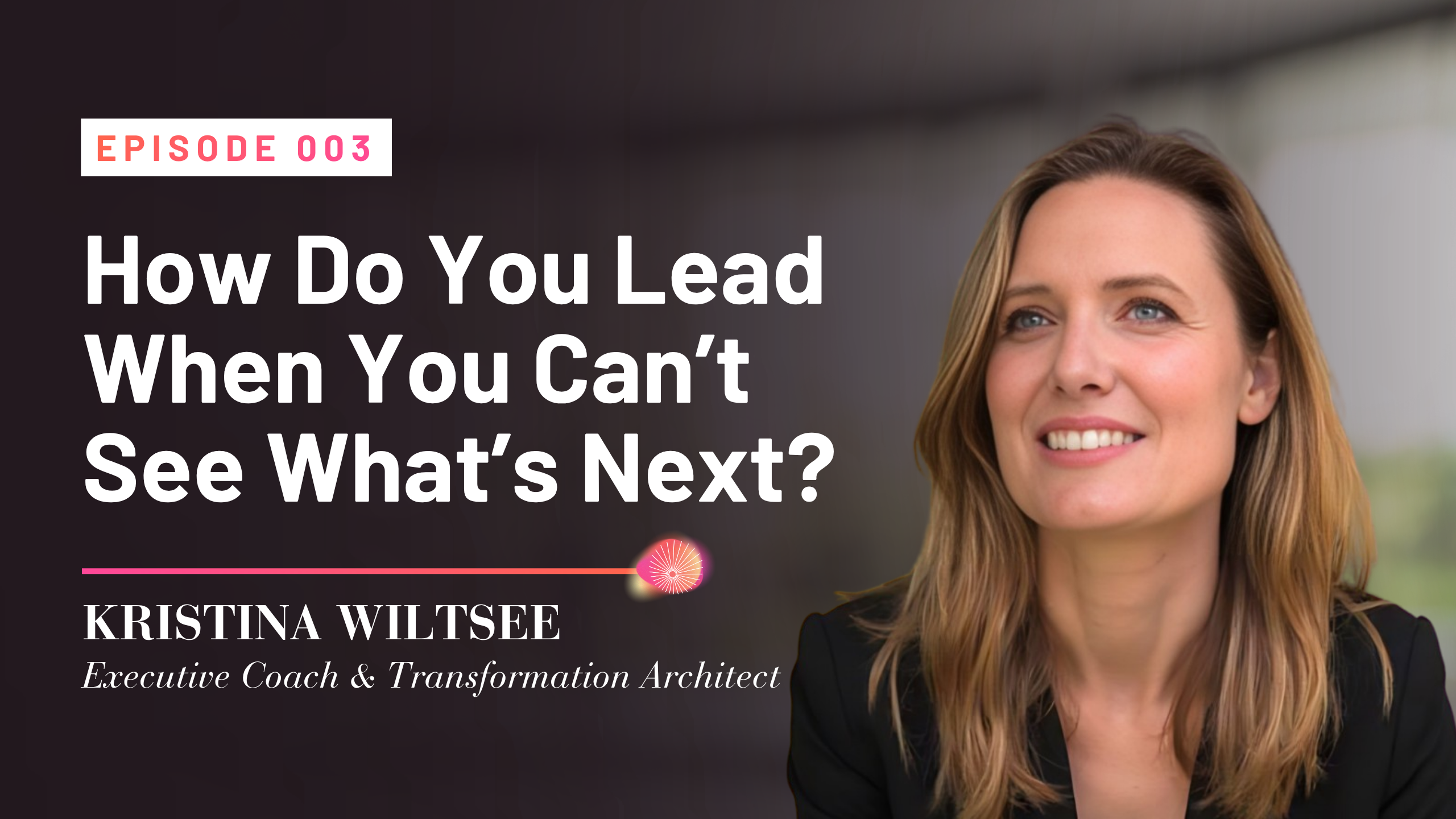
How Do You Lead When You Can't See What's Next?
Key Takeaways
- Leading through uncertainty
- Decision-making under fear and anxiety
- Focusing on what you can control
- Practicing gratitude and compassion
- Choosing hope when the path is unclear
Kristina Wiltsee gave me a useful image early in this conversation.
Leading right now can feel like driving through fog.
The instinct is to turn on the high beams. More light. More information. More certainty.
But if you have ever driven through fog, you know what happens. The light can bounce back and make it even harder to see.
That landed with me because there is no shortage of information available to leaders. News, markets, regulation, technology, politics, wars. Our attention can get pulled toward everything that might happen while the decisions directly in front of us still need to be made.
Kristina’s point was not to ignore what is happening. It was to notice the state we are in when we respond to it.
Fear changes the body. Anxiety changes our attention. If we are asking judgment, analysis, and intuition to work together, the condition we are making the decision from matters.
The conversation moved from there into gratitude and compassion.
Those ideas may sound far away from business leadership. I don’t think they are.
Both can become ways of bringing attention back to the present. Kristina talks about gratitude as something we can cultivate rather than something we happen to feel. She connects that practice to trust, including trust in our own ability to respond when circumstances change.
We ended with hope.
Kristina described hope as a choice to leave a little room for light to come in.
I liked that.
Leading through uncertainty does not require seeing ten steps ahead. Sometimes it means being present enough to see the next one and trusting yourself to respond when the road changes.




Transcript
Brandon Hatton (00:01)
Welcome.
Kristina Wiltsee (00:02)
Thank you. Thank you so much, Brandon.
Brandon Hatton (00:04)
friend
and it's so great to have you in the studios. my god, this is amazing.
Kristina Wiltsee (00:09)
I am so, I feel very honored to be here in your amazing studio and I'm excited about what we're talking about today. It's
Brandon Hatton (00:15)
also call my garage.
Kristina Wiltsee (00:18)
called your garage and it these wonderful remnants of your pottery in the background. I love it.
Brandon Hatton (00:24)
I'm curious what you're seeing right now as you're working with professionals, business owners. What's coming up?
Kristina Wiltsee (00:32)
So what's coming up a lot with people is that there's a lot of uncertainty that's happening in the world that is affecting people's ability to lead because it's like they're driving through the fog and they want to put on their high beams. And of course, as we all know, when you drive through fog,
Brandon Hatton (00:46)
That's the worst.
Kristina Wiltsee (00:47)
yeah. And everyone wants to be able to say, can, can get, you know, let me just shine more light on this. And you recognize that you're not actually really
You're not in a time right now where you can see 10 or 20 steps in advance, right? You can't see two years in advance. You can't see six months in advance. Days
Brandon Hatton (01:06)
Six days in advance.
Kristina Wiltsee (01:07)
in advance. cannot, you're not in a position where you can do the kind of forecasting that I think the C-suite people are trained to do. And so then there can be a floundering that happens as a result of that. So, cause you can have one of two things happen.
Either you're just like, I'm gonna continue as BAU because I've always done it this way. And then all of a sudden you find that you didn't adapt, you didn't do things that were necessary and you are not where you wanna be because the world has moved and you didn't go along with it. Right? That's one. The other thing is that you try and figure out what it is that you're supposed to do, but then you start to just, you you're peddling, you're like, I don't know where I'm going, I don't know what's happening. And you start changing too much.
And then all of a sudden the real kinks in your business, any of the weaknesses start to come to the surface, right? Because you recognize that you don't have the adaptability within your business or within yourself to be able to lead when you're not just doing BAA.
Brandon Hatton (02:06)
Yeah, and so what I'm hearing you're saying, I think in the words that I would use is a lot of analysis paralysis with the inundation of information that's available to us. Yes. And that's counter to being successful or a leader in business. You have to make decisions,
Kristina Wiltsee (02:20)
Absolutely, and I think that what we recognize when we look at, I look a lot at decision making. I think it's a really fascinating topic. I think it's a really fascinating thing to be able to understand and kind of dismantle the way that people make decisions. And when you have the pressure cooker, it changes and it really highlights what your decision making process is. For a lot of people,
they are using their minds a lot, right? To kind of problem solve and I'm gonna do this analytically and I'm gonna say this, this, this and this. But that usually requires that you have a set of facts that you can rely on in order to plug them into the equation to be able to get out what you want, to be able to make your decision. And so I like to encourage people to bring in other forms of recognizing that you're actually not making decisions entirely from your head as much as you hope that you are completely
rational person who's just doing totally analytical process is that there are so many people who are, they're actually making decisions from gut instinct. They're feeling intuitively that they're supposed to go one direction or the other. And they are needing to see that they're in a totally different paradigm and that the more that they can advance this ability and they can recognize that their decision making is coming from multiple different places.
you know, then they're going to be more equipped to be able to move forward.
Brandon Hatton (03:50)
Yeah, so how do I equip myself as a leader, as a business owner, entrepreneur to make decisions based on the realities that I have and even just make decisions, right? Because it is hard to make decisions with so much data. So what are you, how are you instructing people to be in a place
to do that?
Kristina Wiltsee (04:10)
Yes. So one of the things that I like to say is that anxiety is one of these key things that stops us from being up fear or anxiety, or at least is something that actually stops us from being able to move and make the decision that we want to make because, you know, we think, oh, well, I don't have enough information yet, or, I don't know if I can trust this person's opinion or any of these different things that we see. so with any either fear or anxiety, they both have kind of two slightly different remedies, but
that the more that you can counteract those states of anxiety and fear, the more that you can come back into the present moment and actually be able to make a decision and act without worrying about all of the things that your mind is kind of pulling you into or your body is pulling you into this fear. Yeah.
Brandon Hatton (04:56)
Yeah, you actually feel differently when you're afraid.
Kristina Wiltsee (04:59)
Yes.
Brandon Hatton (05:01)
And if I'm using, or if I'm using my body to help me make decisions, then now my tuning fork is off.
Kristina Wiltsee (05:09)
Exactly. that's exactly it. Right. when we see many of us have made decisions, I can think of countless times when I made decisions before I really started cultivating this space in myself, where I would see a situation, I would think, well, this is how it happened in the past. This is how it worked in the past. Okay, so I'm going to pull that piece of information in. I would try and do a pro con list. would try and do a
Right?
My understanding of decision making now at this point, I'm just like, how could I have ever thought that that was going to be the thing that worked? Right? Because it's basically taking a system that really lives in the body and has guidance from the mind, but is not determined in the mind and just giving it all to the mind and just being like, these are the pros and these are the cons. It's like, yes, but how do you feel about that?
Brandon Hatton (05:58)
Yeah
Kristina Wiltsee (05:59)
You know, how do you feel about that pro? You know, it's and and you know, obviously people have adapted that over time. They've made weighted pros and cons and they've made different, you know, comparisons of one thing to another and how things are important. And those are all wonderful because they bring in a level of subjectivity and understanding of how we feel about something. But ultimately,
when we are in a stress response state, so fear or anxiety, your prefrontal cortex no longer works, you are working from a different part of your brain, and you're making different decisions as a result.
Brandon Hatton (06:33)
Yes. And what comes to mind when you say that is they, whoever they are, the media, the social media, people who want my attention are always trying to get me there. So I watch them so that I pay attention to them. And they trick me. They try to trick me into believing I can make a change over there all the time. And then therefore I lose a factual change in my job and my life, my
my whole, my business.
Kristina Wiltsee (07:02)
Yes, absolutely. And so if you recognize that spectacle is made that much more potent, so the media and everything that's happening outside has made that much more potent when you put survival in the mix of it. Yeah. When you make it feel as if when you're mixing these two things around, it's like, want your attention. And in order to get your attention, I'm going to make you feel like you're in danger.
Brandon Hatton (07:25)
This is the end of our democracy. Wait, we had one? Joking. No, but it is. It's always, this is the end of, they're ruining us. And look, I'm not downplaying it. There's some real danger out there. There's some real danger out there. There's a lot of cruelty. But what I hear you saying is, and I love that analogy, if I turn my brights on in fog, if I try to give attention to all of it, I will blind myself.
Kristina Wiltsee (07:48)
Exactly. Exactly. So what do you do when you're in fog? You are looking at each foot that sits in front of you and you are bringing back your attention. You are bringing back your focus into the space, into what you can control, which is how you are dealing with the situation. Right. And so you, and that is, and that's going to bring everything back online. That's going to bring
the mind back online, it's gonna make it so that you are able to have more complex thinking processes going on. It's gonna allow the body to come back online so that you can actually have intuition. what I say is that we cultivate metastates. We are great at saying, I know I want to build my core strength, so I'm going to do Pilates. Or I need to strengthen my heart, so I'm gonna run and I'm gonna do cardio.
We are also actually pretty good at this point of there are a lot of people who are recognizing mindfulness meditation as a wonderful way to Strengthen their mind right sure because they're saying because in doing that you are creating an observer You're strengthening the observer of your system. Yeah, and when you can create distance between the moment the heat of the moment and Your ability to observe yourself in the heat of the moment then you're gonna be able to better equipped to do that and
but what we don't do a lot of, and this is one of those things that it's like, as we learn collectively how to manage these systems better, is that we recognize that we have states within us that we kind of treat as accidental. I'm talking about gratitude, that feeling of overwhelming gratitude that you can have, or that feeling of overwhelming compassion that you can have, or that feeling of...
excitement and inspiration. we have a tendency to think that we just stumble across it. And for the most part, many people do because they don't try and cultivate that state directly.
Brandon Hatton (09:47)
So how do I cultivate compassion and gratitude? Let's give our members two takeaways, actionable takeaways, cultivate gratitude and compassion.
Kristina Wiltsee (09:57)
Yep. So with gratitude, always say that gratitude is developed first by seeing if you can evoke the state at all. Yeah. Right. You're just like, I can think of the word gratitude or I can think of something I'm grateful for. Really easy. Hey, I am grateful to be sitting here with you right now. Yep. Okay. Got it. Can I actually feel that in my body? I don't know. I don't know. Maybe you can, maybe you can't, but guess what? You're grateful for either one.
Yeah, okay. You're grateful for whether or not you can feel it or whether or not you can't. Yeah. And then that's when you start to come into indiscriminate gratitude. Indiscriminate gratitude says, I'm not just making a gratitude journal for everything that I'm like really glad happened today. That's a wonderful practice. And we can do more. Okay. And we can say, I am grateful for what I have and what I don't have. I am grateful for what I want and I don't want. I'm grateful for all aspects of how indiscriminate, of how gratitude affects my life.
And in doing so, you pull yourself back into experiencing the present moment.
Brandon Hatton (10:57)
I can give you an example of that in my life. I work in a lot of groups. For instance, I'm in this improv group and they say, how are you feeling today? One to five. And every day I say five. Cause it's like, why am I judging how I'm feeling? why people, and I understand why people say two and what they mean when they say two. But for me, I'm like, I'm a five and I'm just going to accept the way that I am and be grateful for the way I'm feeling. Cause for whatever reason, that's just where I'm at.
Kristina Wiltsee (11:22)
Yeah, that's brilliant. That's brilliant. Yeah. Thank you. I mean, kind of brilliant.
Brandon Hatton (11:27)
Yeah, but it's like it is little practices like that. So gratitude is just or you know, we were in the center, the new building that conscious wealth is in today. And every time we lost the deal, we lost three deals before we found this building. And I wanted everyone so badly. And everyone we lost, I was sad and grateful that it fell through because I knew there was a reason why we weren't in that building. And you know the reason? Because we're in this building.
Kristina Wiltsee (11:53)
Yes.
Brandon Hatton (11:54)
It's
amazing. Yes, it was out there just waiting for us.
Kristina Wiltsee (11:58)
Right. And I think that's one of the, that brings up like this really key, like kind of nugget that sits within gratitude is this recognition of like, you can have trust in a lot of things. Some people have faith. They have faith that sits, that says, believe that this is, you know, kind of what you're talking about. Some people have religious faith, but other people just have faith that it's going to work out. It's
Brandon Hatton (12:17)
That's abundant,
Kristina Wiltsee (12:19)
a level of abundance. Right. And I think that being in gratitude really does strengthen faith and trust.
And whether it's trust in just yourself that you know you're going to be able to work it out, like if you don't want to extend it beyond yourself and you just want to extend it, you don't want to say, the universe or some, you know, or some God for those who believe in that. Right. I think it's a really wonderful practice to see that. The second is compassion. Right. So compassion is, as we can see, there's a passion aspect of it and there's calm. Right. So it's like a communal passion. Right. It's like, but it's also what we know is compassion is this idea of like when you see somebody else suffering,
you feel for their suffering, right? And what does that mean exactly? Like, how can somebody say that that's useful? I think of compassion as a currency of love, right? There's gratitudes, a currency of love and compassion is a very important one because it's important to become aware of everything that's going on and recognize that you're not there to rescue everybody, but you can recognize and reflect and be like, yes, we are in this human experience together.
And I have so much compassion for you in this moment. I have so much compassion for myself. It's like saying I'm sorry, but in English language, just, I'm sorry doesn't, I'm sorry is like mixed up in the whole like I did something wrong to you, that whole aspect. So with compassion, I always talk about this idea of, there's a practice called meta, which is loving kindness.
in its most basic form, it says, may all beings be happy. And that is the basis of this practice, which says, know that people are suffering in the world. I know there is difficulty, but I actually am capable of creating a force within myself. Even if it only ever goes within the boundaries of my own body, in which I'm just like, yes.
May all beings be happy. Let's just all can we all get through this somehow?
Brandon Hatton (14:14)
practice
of meta and we've never spoke of this before but I believe this to be true for my studies is that I get this feeling of gratitude I get this feeling of love it's a actual somatic feeling and then I think of other people who are suffering and I wish them that feeling so it's not only me just saying I wish them compassion it's me extending that feeling that I have to them
Kristina Wiltsee (14:39)
Yeah, and I think that that's a really good point. It's like whatever gets you in that state is a wonderful thing. Right? Right. And so for me, when I first learned how to do Metta, I learned of it as kind of being in a state of equanimity in my body, right? Like I was like, this is... But the words themselves, I almost like like, it's like the words themselves had been said by however many meditators...
however many centuries and it has this like feeling, it has this connection in which it's almost, it's like it carries an energy on it. And by thinking it, it takes care of it.
Brandon Hatton (15:15)
I like that. Right. Yeah. And so for any of our members out there who are wondering, wait, I thought this was like a podcast or a conversations for business owners or entrepreneurs who are scaling and exiting their business. It really is. And that's what Christina does to help others. She's helped our clients and work directly with them. Sometimes they get stuck helping them shift to get unstuck. This is all legit. This is all something you need to lead a business.
in such uncertain times, whether it's tariffs, it's ice raids where you don't know if your workers are coming into the, they'll be able to come, they'll show up. There's who knows what next problem we'll have, where there are multiple wars going on. And so being able to focus and I think remain, we should say growth mindset, cause it's one of the foundations of conscious wealth, but I think it's one, it's maintaining hope.
How do you think let's let's finish up on hope
Kristina Wiltsee (16:11)
Hope is the little bit that you want to draw the shades back and let the light come into your experience. I think it's a really, it's very cliched in many movies they talk about, well, what makes a human a human? It's hope, or what do we have left? We have nothing left. We're at the nadir of the experience. We're at the lowest point of humanity. What do we have left? And what is our unique quality? It's hope.
And I don't think as hackneyed or cliched as that may be in that depiction, I think that it conveys something very, very important, which is this idea that it is a choice. Hope is a choice in many ways, right? It is a choice that even in the darkest of times, you recognize that you are willing to let in that much, you're willing to leave a space for light to come in.
for the potential for something to get better, for the potential for you to experience more love, right? Even if that's your version of better, it could be that your version of better is, you know, I can make payroll. It could be that your version of better is any of these different things, but this idea that you're willing to say that if I move forward in presence and I have trust in myself to be able to handle what's going on and what's happening, if I have gratitude for the present moment, which is going to build that trust,
If I can do that, then I can move forward with the conviction to know that I can handle anything.
Brandon Hatton (17:45)
I can handle anything. mean, that is so what we believe at Conscious Well. So thanks for coming on. Thanks for hanging out in the studios and come back soon.
About the Expert

Subscribe





All insights
Explore by topic.